by Bob Blubaugh, photography by Nikola Tzenov
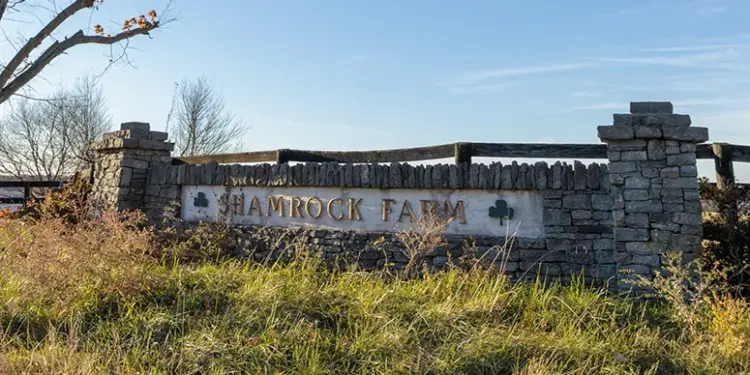
Numerous rails and more than a few posts are missing from the fence surrounding historic Shamrock Farm in Woodbine.
The outbuildings show significant signs of age, unsurprising given that the thoroughbred breeding farm was established shortly after World War II. Overgrown brush and weeds partially obscure the name adorning the stone wall that identifies the property.

A sign greeting visitors at the farm’s driveway entrance confirms the obvious: “Sorry, we’re closed.” But not for long. Shamrock Farm, founded in 1948 by Pittsburgh Steelers owner Art Rooney and run for nearly a half-century by legendary Carroll County horseman Jim Steele, is set for a second life as a state-of-the-art training facility viewed as a cornerstone of a larger overhaul designed to revitalize Maryland’s horse racing industry.
“It’s great for Carroll County,” says Board of Commissioners President Kenneth A. Kiler, who grew up around thoroughbreds. “Horse racing in Maryland needs a push.” A considerable portion of this push will emanate from deep in the heart of Baltimore Ravens country at a facility formerly owned by Pittsburgh’s first family of football.
There, a stallion named after Steelers Hall of Fame quarterback and Super Bowl MVP Terry Bradshaw once stood. Kiler says he envisions the facility having a positive, significant local economic impact.
“It will be great for restaurants in the area and other local businesses,” he says. “They’re looking at bringing 800 horses [to train] there. They’ll need haulers. Somebody’s got to shoe the horses, provide medical help, muck the stalls, clean up — all of [those jobs] will be as open as can be to Carroll Countians.”
Envisioning A ‘World-Class Training Center’
The Maryland Thoroughbred Racetrack Operating Authority (MTROA) was formed in 2023 to design and implement a long-term strategy to help make racing sustainable and eventually flourish in the state. The MTROA described Shamrock Farm as “the ideal location for a world-class training center” in a May 7, 2025, press release shared by Maryland Gov. Wes Moore and the Maryland Board of Public Works.

This release announced the state’s acquisition of the Woodbine property as well as a plan to demolish and rebuild historic Pimlico Race Course in Baltimore. Pimlico is the site of the second jewel of the Triple Crown, the Preakness Stakes, as well as the future home of all Maryland racing. Most of the horses that will be running there regularly will be stabled and trained about 20 miles to the west, at Shamrock Farm in southern Carroll County.
“A lot of thought went into it,” says Timothy L. Keefe, a trainer in the state for more than 30 years and a former president of the Maryland Thoroughbred Horsemen’s Association.
Keefe was named a member of the Board of Directors for the Maryland Jockey Club, which absorbed the MTROA and will operate Pimlico and Shamrock Farm. He spoke in glowing terms about the 328 acres of Shamrock Farm purchased by the state to help transform the industry.

“It’s a great setting, beautiful, rolling hills. It will be a showcase of a facility,” Keefe says. The facility is expected to house more than 800 stalls. It will include a one-mile dirt training track designed to replicate the Pimlico racing surface. Additional features include multiple barns, modern veterinary and administrative buildings, and on-site housing to support backstretch workers.
The MTROA searched for more than a year to find the best possible location for the training facility. It ranked possible sites based on location, natural resources, topography, transportation and access, utility infrastructure, jurisdictional approvals, size and acquisition and development costs. Shamrock Farm received the highest score.

Kiler says that Shamrock Farm won out over at least seven other sites across the state. Its proximity to Pimlico and the county’s willingness to make a financial commitment were factors in the decision. The purchase agreement for the property was for $4.48 million. The Maryland General Assembly committed at least $110 million out of a larger horse racing package of $400 million in state bonds toward the new training center. Carroll County will contribute $1.5 million.
Gregory A. Cross, chairman of the MTROA when the decision on Shamrock Farm was made, says, “Our goal is to design and build one of the great equine training centers in the world,” via the Governor’s Office and Public Works joint announcement. “The collaborative decision to build at Shamrock Farm included input from Maryland’s horsemen and other key stakeholders. This project truly continues the path for our racing industry to thrive.”
“This is a win-win for Maryland racing and for Carroll County,” says MTHA President Katharine Voss via a press release following the state’s May 2025 announcement. “It’s an investment by the State not only in the future of our industry, but in the preservation of agricultural land and the economic vitality of the region. … This is a bold investment in the people and horses who power our sport.”
How Will Southern Carroll Be Impacted?
The positive reaction toward the development of the new training facility was widespread but not universal. County Commissioner Michael Guerin represents District 4, the southwestern portion of Carroll that includes Shamrock Farm. He says the project would represent a significant change for the Winfield and Woodbine areas. Residents voiced “strong and reasonable concerns” during a forum he hosted in Winfield, where more than 120 locals gathered to discuss all aspects of the proposed facility and provide what he termed “important feedback.”

“The key issues raised included potential impacts on traffic flow and the capacity of our local road network, the Route 26/Woodbine Road intersection, environmental considerations, particularly concerning existing wells and septic systems, and the anticipated broader effect of the facility on the character of the surrounding area,” Guerin says.
“Residents voiced concerns regarding the aesthetic design of the development, the capacity of the local electrical grid, fire protection services and the importance of ensuring that the Carroll County government has an effective channel for communicating local input throughout all phases of the development process.”
Guerin has been in direct contact with the Maryland Stadium Authority project team and appreciates their receptiveness to the issues brought up by his constituents. Kiler thinks residents’ fears can be alleviated through effective communication and the state’s commitment to nearby infrastructure.
He says part of the agreement with the state includes a traffic study. The work done to upgrade intersections and implement other improvements should go a long way toward addressing concerns.
Kiler says it is difficult to put a timeline on when the facility will be racehorse-ready. The nature of the sale, from an estate with numerous named owners, makes for a time-consuming transaction. Plus, the financing is complicated. “It’s moving forward,” he says.
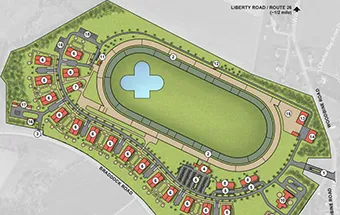
Carroll County land services have already been allowed on site to begin work, and significant construction is expected to start in 2026. The ideal scenario is that the training center will be open and in use when Pimlico reopens in time for the 2027 Preakness. Laurel Park, in Prince George’s County, is currently being used for racing and training. It will be permanently closed once Pimlico and the Shamrock Farm training center open.
Keefe concedes it will be a different path once the Shamrock Farm facility is up and running and racing returns to the refurbished Pimlico Race Course. “It’s certainly a change and different from what we’re used to,” he said.
“Basically, [the racehorses] were mostly housed at the racetracks at Laurel, Bowie and Pimlico. As things have consolidated … the vast majority are at Laurel. It will be a big change to close Laurel Park and have everything out in Woodbine, but it will be a positive change.”