
by Kym Byrnes, photography by Nikola Tzenov
In a cold winter evening in a Carroll County high school gym, the bleachers are filled with cheers
as the basketball game reaches its final quarter.
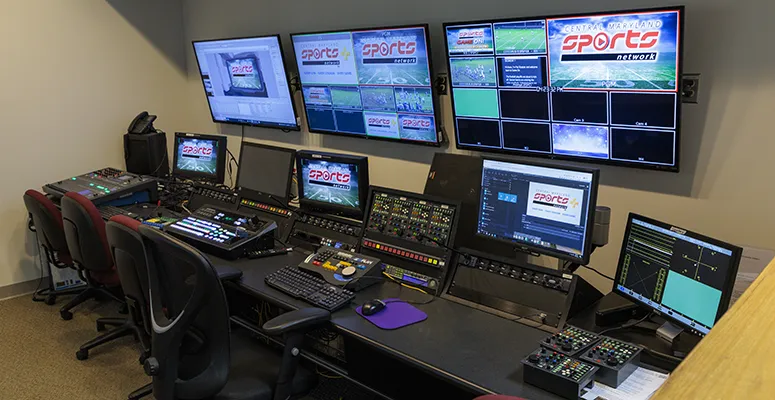
Cameras capture every fast break, free throw and buzzer-beater, while commentary flows from a makeshift broadcast booth tucked into the gym.
On screens throughout Carroll County, families and fans who couldn’t make it in person are watching live, celebrating every moment with the same energy as those in the bleachers.
High school sports coverage is the new reality at the Community Media Center of Carroll County (CMC), where public-access television has evolved into a hub for local storytelling. Under CEO Richard Turner’s leadership, CMC has transformed from a traditional public-access station into a multimedia platform connecting the county’s residents through the stories that matter most to them.
“For decades, CMC has been about giving people a voice,” Turner says. “Now, we’re using sports as a way to tell those stories, celebrate our youth and bring the community together.”
A Legacy of Community Storytelling
CMC’s roots stretch back to March 1989, when Channel 55 first went on the air. From its earliest days, the station’s mission was simple: empower Carroll County residents to share their stories. By 2000, a new franchise agreement and a nonprofit board were in place, laying the groundwork for a permanent public, educational and government (PEG) media facility.
The vision was ambitious: create a shared space where local channels, the public and students could produce content while learning real-world media skills. When the new media center opened in 2003, it offered a home for everything from municipal meeting coverage to local productions, along with hands-on opportunities for local high school and college students.
Over the years, CMC expanded its reach with additional channels, including Channel 23, the Town and Community channel, and HD-1072. Even as technology and media consumption evolved, the center remained committed to its core mission: providing residents with the tools and platforms to learn, communicate and engage with one another.
Leaning Into Local Sports
Around 2017, CMC began to explore a new way to engage the community: high school sports. What started as a small experiment — with a handful of cameras and volunteer crews — has grown into a full-scale production operation streaming dozens of games each month. The programming now includes highlights, in-depth commentary, athlete profiles and special features on standout student-athletes.

Pat Stoetzer, a former sports editor for the Carroll County Times, is now the face of CMC’s sports coverage. He says the transition from writing to broadcasting has been exciting and challenging.
“Technology can come with a lot of challenges, but we have a great team, everyone works together to solve problems when they arise,” Stoetzer says. “We’ve really ramped up our coverage, so now there are nights where we’ve got crews at multiple locations livestreaming and we’re also on-site somewhere broadcasting live.”
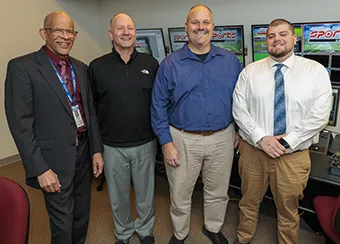
Turner explains that sports became a natural extension of CMC’s mission. “Sports have passion behind them. We love to love a team,” Turner says. “Local sports remind us that even though we do have differences, we have a lot in common. We come together in those stands and experience the joy of our athletes, and that is extended to those streaming the games at home.”
Data from the CMC suggests that people are watching. According to Turner, social media traffic is increasing dramatically year over year. In 2025, Facebook traffic increased by 115%, Instagram views by 345%, and their total combined yearly views across platforms by 278%. Michael Duffy, supervisor of athletics for Carroll County Public Schools (CCPS), notes that since taking the position in 2019, he has been fostering a relationship with CMC.
“We have collaborated to stream contests of the week in [various sports each season], as well as streaming the entirety of our county wrestling tournament and highlights for other sports,” Duffy said. “Pat Stoetzer and I record a weekly podcast, ‘The Score and More,’ to showcase our students, coaches and teams.”
The streaming service is perfect for friends and family who can’t attend games in person, but its appeal extends beyond that. Turner has seen fans in the stands using the stream to follow commentary and replays in real time. Athletes, meanwhile, often watch their performances and review competitors’ games on the CMC YouTube channel.
The live and archived videos, commentary and highlight reels also help young athletes promote themselves. Francis Scott Key (FSK) High School’s athletic director, Ryan Kimble, says that the media coverage helps athletes get recruited. “Social media has a huge influence on sports and the recruitment of our athletes,” says Kimble, the former FSK head basketball coach. “CMC has provided our kids a platform to get our stories shared, and the additional coverage and social media highlights make CCPS athletes more recruitable.”
Looking Ahead
Most recently, CMC has worked to evolve cable channel 18 into a 24/7 local sports stream for Carroll Community College’s Lynx sports contests as well as local high school sports games and programming. During the COVID-19 shutdowns, CCPS entered a partnership with the NFHS Network, which streams live and on-demand high school sports, to provide subscription-based streaming of Carroll’s high school sports games.
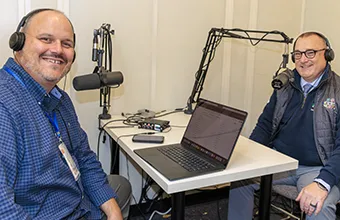
Duffy record a weekly podcast The Score and More to showcase students coaches and teams
This year, CCPS did not renew its contract with NFHS; instead, it entered into a partnership with CMC to stream games from every school in the county. Currently, this camera infrastructure is being installed, and soon CMC will offer a subscription service, CMSportsNet+, allowing people to watch games and programming live and on demand.
Turner says the subscription model will expand accessibility while sustaining the nonprofit. He notes that, in September 2024, CMC covered about a dozen games, and this year they covered 55.
Approximately 140 games could have been covered. “That’s the scale we’re talking about here,” he says.
“When you think about trying to cover that number of games with no additional budget, and in fact a smaller budget than the year before, it’s a massive undertaking,” Turner says. “Our goal is to raise some additional revenue through [the subscription] to employ additional technology and increase coverage across the county.”
Turner says that free content will still be available without a subscription. “Right now, there’s a major initiative to increase our volume of coverage,” Turner says. “We want as many girls’ games as boys, and as many junior varsity games as varsity. We’re also adding additional features like graphics on screen to help tell the story.”
But more technology and coverage mean more hands on deck. Turner says they will need more volunteers for everything from working equipment to gathering statistics and announcing games. He says they are building more opportunities for interns and volunteers to help people advance their careers in technology, sports and journalism.
As the final buzzer sounds in the high school gym, Stoetzer signs off, and the crew begins packing up cameras. For many, it’s just another Friday night, another game. But for CMC, it’s a reflection of decades of growth, experimentation and commitment to community. From its early days as a public-access channel to its current role as a hub for local sports coverage, the Community Media Center of Carroll County continues to connect residents, celebrate achievements and provide a platform for every voice to be heard.
“I think it is incredibly valuable to our community,” Duffy says. “It is usually much more than just a video feed; it is frequently play-by-play and commentary. I’m not aware of any other jurisdictions that have a local media partner providing this level of coverage.”