
by Lois Szymanski, photography by Nikola Tzenov
In Carroll County, not everyone is walking a Labrador or cuddling a tabby. Some residents are wrangling dwarf goats, feeding ferrets, caring for wide-eyed axolotls, and dust-bathing chinchillas. Around here, pets come with hooves, whiskers or gills.
Nigerian Dwarf Goats
Kate Fisher laughs when talking about the Nigerian Dwarf goats on her family’s Bumbling Bee Farm in Westminster. “They’re adorable menaces,” she says, while sharing a story about visiting two nursing homes in Hanover, Pennsylvania.


“One gruff gentleman at Homewood Living Plum Creek said no, he didn’t want to hold a goat. He positioned himself in the back of the room, but kept inching closer.
A bit later, I noticed he had one in his lap. By the time we were leaving, he was trying to convince the staff to let him have one in his room!” she recounts.
Fisher shares that she has to place baby goats in diapers, with onesies on top to hold them in place, for visits to senior living communities.
Nigerian Dwarf goats grow to anywhere between 18 and 24 inches. Fisher says male goats make the best pets after castration, as they become calmer. Their doe, Marge, is a beloved pet.
“She reminds me so much of a dog,” Fisher says. “When I’m doing chores, she comes up and paws at me, and she’ll rest her forehead on mine. There’s a bond just like with a dog.” Goats need strong fences, access to hay and loose minerals, and space to browse.
Browsers eat woody stemmy plants, too. They get regular hoof trims every two to three months and thrive in cold weather without coats or heat lamps. These goats can live between 12 and 15 years.
“We supplement with pellet feed in the winter,” Fisher adds. “They’re curious by nature and not designed to be house pets. They would injure themselves inside.”

Axolotls
Finksburg resident Noelle Johnsson once immersed herself in the world of axolotls. She once had hundreds, selling them for $100 to $150 each. Now she has only three 7-year-olds named Kipling, Kaidan and Kipson.
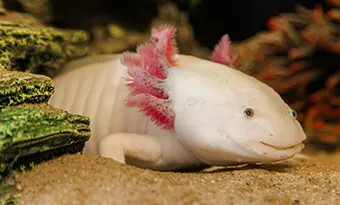
Also known as Mexican walking fish, these unique amphibians can regenerate most body parts, including parts of the brain, making them a focus of medical research. “Axolotls originated from just one place in the world, Lake Xochimilco in Central Mexico,” she says. “Now, they’re considered functionally extinct in the wild, but they’re thriving in the pet markets.”
An axolotl can grow to 12 inches long and needs a 20- to 40-gallon tank plus a double filtration system. “They produce a lot of waste, so you need a filter rated for twice the size of the tank,” Johnsson explains. “I have two on my tank, and they cost $300 each.” According to Johnsson, axolotl feed can be earthworms or salmon pellets. A $20 can of salmon pellets lasts a long time.
Axolotls have cool personalities, she says. “They see me and come to the side of the tank to beg for food.” Axolotls can live for 10 to 12 years and are best purchased at a reptile show.
Ferrets
Johnsson’s two ferrets, Mabel and Gwin, are spunky and full of play. “They know their names and have their own personalities. Mine come when called, and you can train them to do tricks like a dog,” Johnsson says. “They’ll get into everything, so I put them in a playpen during the day.

“Ferrets have to be fed constantly,” she adds. “They eat all day long but never get overweight.” Johnsson buys her ferret feed from the pet store. Ferrets must use a litter box with stove pellets as the base.
“Ferrets from pet stores are usually spayed or neutered. That affects their hormones, making them more prone to insulinoma and adrenal gland disease,” she says. “Sometimes they need to get implants to mimic natural hormones and prevent these diseases.” Ferret owners also need to monitor for blood sugar and digestive issues.
For those looking to buy one, Johnsson suggests attending American Ferret Association shows. Johnsson’s ferrets cost about $37 a month to care for.
Hedgehogs
Donna Walsh has owned many exotic pets over the years, but the Hampstead resident says her hedgehog, Sky, is definitely unique. “She’s curious and gentle, but also very nosy,” she says, “never aggressive.”
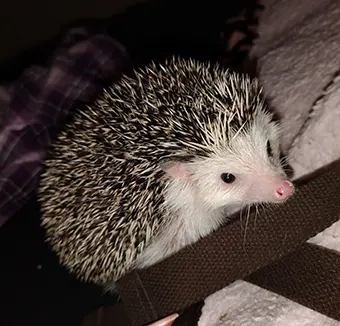
Taking the size of a grapefruit when they’re balled up, hedgehogs live wild in regions of Africa, the Middle East, Europe and Central Asia. Although covered in quills from the head to the tail end, hedgehogs won’t throw their quills like a porcupine.
“They don’t like to be handled and will ball up and stay in a ball if you handle them. This is to defend their belly, which is soft and doesn’t have quills,” Walsh says. Sky’s quills are sharp, so if Sky goes into a ball, Walsh uses a shirt to pick up the hedgehog so she doesn’t get poked. Handling can be tricky at first. Walsh says that daily socializing helps them feel safe. She uses a T-shirt that has her scent to pick up Sky.
They are “nocturnal, solitary and shy, [but] social with handling and trust. They’re happy by themselves,” she explains. Hedgehogs have square teeth that don’t easily break the skin if they bite. Sky lives in a rabbit cage with a plastic floor because a hedgehog’s tender feet can’t handle wire.
Walsh uses pelletized bedding with paper bedding on top. The pellets absorb moisture while the paper bedding allows Sky to dig, which hedgehogs like to do. Sky eats high-protein cat food, hedgehog pellets and mealworms.
At night, she’ll dig and run around her cage or go inside her fabric hut. The cost of a hedgehog runs anywhere from $50 to $350.
Chinchillas
Liivi Sharp has had her 21-year-old white chinchilla, Siku, since it was a kit. She also has a 6-year-old gray chinchilla named Nibbler at her home in Westminster. “Their fur is their No. 1 wow factor,” she explains.
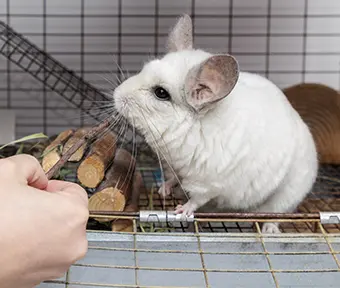
“It’s so soft. They are curious by nature, and each one has its own personality. Some don’t like to be touched, while others like to be scratched. Some are cuddly, and some are not. Some like to sit on your shoulder. When they hold their food to nibble on it, they are so cute!”
The nocturnal critters stay busy at night. They sometimes take dust baths to clean their fur, rolling in powder obtained from a pet store.
The cost of a chinchilla varies. An exotic color like her Wilson White might cost $500, but a standard color like her gray might be $150. Setup is the biggest expense of owning a chinchilla.
“We have a large wire cage with multiple levels for climbing and stones and tiles they lay on to stay cool,” she says. “Chinchillas originated in the Andes Mountains and don’t do well in the heat. Temperatures can’t be above 72 degrees.”
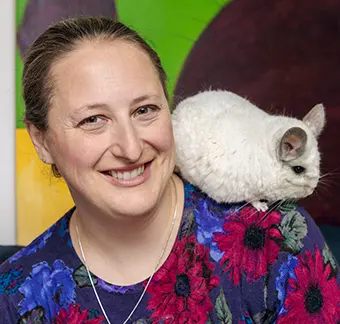
Because their teeth are always growing, chinchillas need a safe wood to chew on, such as applewood, willow, or pine. Their diet consists of dry grass, food pellets and water, plus dry treats such as rose chips, rolled oats or unsweetened cereal.
They live 15 to 20 years. Liivi estimates feed and supplies cost about $50 a month. Before buying a chinchilla, she hopes folks realize owning one is a long-term commitment.