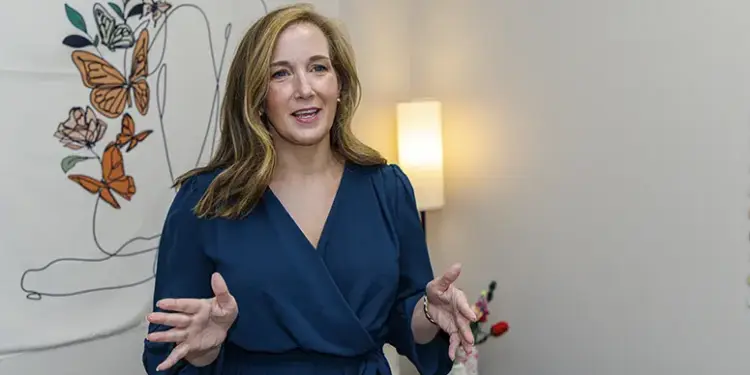

by Kym Byrnes, photography by Nikola Tzenov
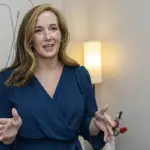
Stephanie Powers has spent much of her career doing the kind of work that asks for equal parts compassion, resilience and resolve.
A licensed therapist and longtime advocate for survivors of sexual violence, Powers now leads CARE Healing Center as its executive director, helping shape both the services it provides and the way the community understands sexual violence, trauma and healing. Her approach is grounded in a simple but powerful belief: People deserve to be heard, believed and given the tools to move forward.
How did you come to live in Carroll County?
I was born and raised in Baltimore City. My husband was born and raised here. We moved here in 2013 when our kids were little, and in 2020, we moved to Utah for two years because my husband’s company relocated. Then we moved back.
Did you always plan to go into this line of work?
My career and experience are built on learning to teach someone how to rescue themselves. In college, I started working as a sexual assault educator, which led me to my first job out of college at a domestic violence shelter. I always thought I’d do therapy for children, and when I first got my master’s degree, I saw only children. Then, when I had my children, I had to tap out. The work hit too close to home.
I’m a licensed therapist and had previously worked in Harford County in their rape crisis center, so when I moved here, I missed that work. I started volunteering at the [Carroll County] agency in 2017, which turned into some work on a grant. I became the clinical director; then, in 2023, I took over as the executive director.
In 2021, the Rape Crisis Intervention Service of Carroll County changed its name to CARE Healing Center. Did anything else change?
We do the same work we’ve always done, but we now offer other services. In 2022, we started doing all human trafficking cases in the county, and now we offer legal services. If someone needs legal support, like a protective order, now an attorney can go with them that day.
How prevalent is sexual violence?
If you look at national statistics, one in three women and one in six men will experience sexual violence in their lifetime. Last year in Carroll County, we saw 250 clients. It’s hard to put in perspective because sexual violence is the most unreported crime; it’s the only crime where the survivor blames themselves. It’s really hard to quantify how prevalent it is in the county.
How is the organization evolving to meet the community’s needs?
This was always a volunteer-run agency, which I saw as problematic. There wasn’t a place for people to get quality services for these issues because we were volunteer-based; we didn’t have clinical options. We know if you hit sexual violence head-on and deal with it, it doesn’t have the same repercussions later in life. We’ve moved from a volunteer agency to a staff of 14, including five licensed clinical professional counselors (LCPCs) or social workers who provide services and four paraprofessionals who are working toward licensure.
What role do volunteers play at your organization?
We have about 20 active volunteers, and they take over the help line after business hours and go to the hospital for forensic exams. We are always in need of volunteers. COVID-19 impacted the number of volunteers, and at various times of the year we see an increase or decline in people’s availability. We also have volunteers who help at events and with planning things. All of our volunteers go through pretty intense training about trauma-informed care, what sexual assault is, how to respond and how to practice self-care.

What about your work or organization might surprise people?
We are part of the health curriculum for Carroll County Public Schools, so starting in sixth grade, we’re part of every Health 1 and 2 class. We are not teaching about sex. We are talking about power and control, and about ways for kids to stay safe, especially with technology. We are authorized to train through the National Center for Missing and Exploited Children on how to stay safe online, recognize grooming and teach kids how to advocate for themselves.
People are also surprised that trafficking is happening right here at home. In human trafficking, a target must be vulnerable, so kids who aren’t having their emotional or physical needs met at home [are at risk]. Perpetrators build trust, then play the long game; eventually, it turns into a boyfriend model, and someone they trust asks them to do a favor to help them out. Maryland just passed a new law requiring school administrators to have a standard protocol for responding to allegations of abuse. So if a kid tells a principal something about someone, there is now a law that the school has to have a unified response, a standard protocol to deal with that information.
What do you like about the work, and what keeps you engaged?
There’s a lot that I love about it. It’s rewarding in that when you are working with someone on the worst day of their life, you can be a bright spot that empowers them in that moment, to say, “I believe in you. I don’t care what you were wearing.” No person deserves to be assaulted. We are the ones who hold the hope. When a person thinks their life is over, we can help them realize it wasn’t their fault and help them reshape their worldview.
What are the challenges of the job?
The social stigma involved. I always say I’d love to be out of a job. This is my 20th year in this field, and the number of survivors is growing every year. And, of course, funding is always a challenge. Our local government is super supportive and has been willing to support our budget when we need it.
Are we moving the needle in terms of addressing and curbing sexual violence?
We’re doing more education; the hard part is there’s not a lot of deterrent, not a lot that goes to perpetrator accountability. In all the time I’ve been doing this work, I’ve only had about six people go to court, because the burden of proof is on the survivor. Some really powerful moments keep you coming back to the room — those aha moments for the clients. Sometimes, the only justice a survivor sees is in getting themselves help and finding the strength to speak their truth to their abuser.
Are there misconceptions you would like to dispel?
I think that because our services are free, people equate that with not being qualified. All of our therapists are licensed in the state and have had a ton of training or are certified in this type of work. Sadly, I also think a lot of people don’t even know we exist until it’s too late.
What’s ahead for your organization’s work?
I’m proud that we’re emphasizing prevention and legal services. What we’re focused on right now is getting new office space. The county has provided us space since 1986, but we’ve grown, and our needs have grown, and we’re in an old institutional building. We want to expand so our clinical space is trauma-informed and makes you feel safe, sending a message that you deserve better. We have half our staff in one office and the other half in another space. We’re looking to create our own space. We want to expand trauma services and look at other forms of violence and how we can provide those services.
What final message do you want to leave with readers?
All of our services are anonymous and confidential, and it’s OK if people call us, word-vomit everything and then never call us again. It really can be calling anonymously, sharing and getting information, and that can be it. We’re here for as much or as little as you need it.