by Lois Szymanski, photography by Nikola Tzenov
Those who care for horses are probably familiar with the old saying, “The bigger they are, the gentler they are.”
As a lifelong horse-lover who writes books and articles about horses and ponies, I live and breathe equines. You can imagine my excitement when an opportunity arose to visit a horse rescue in Mount Airy. Gentle Giants Draft Horse Rescue doesn’t just rescue horses; they rescue the biggest horses of all.

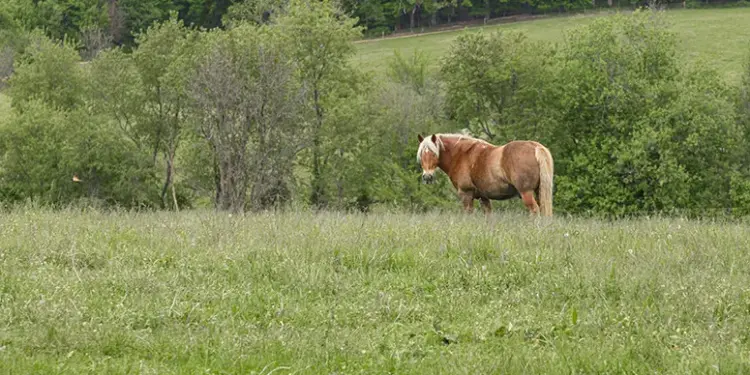
Draft horses tower over the average person, yet seem to have gentle hearts. They reach up to 2,000 pounds and are so tall that two miniature horses could walk right under them. Muscular and heavily boned, they reach 16 to 20 hands tall. That is over six and a half feet, measured only to their backs. This measurement doesn’t include the added height of their arching necks and massive heads.

On one recent warm April morning, Gentle Giants Draft Horse Rescue buzzed with the activity of volunteers. A Gator lumbered up the hill toward a field full of blind horses.
Executive director and founder Christine Hajek says she grew up with horses and was inspired to start the rescue. She’d been taking riding lessons at a barn when, one day, her regular lesson horse was unavailable.
The horse she was assigned was a Clydesdale, the breed associated with the Budweiser wagon. That encounter was all it took to help her fall in love with giant draft horses.
Hajek eventually purchased an old Amish plow horse of her own named Elijah at auction. The seller was in tears, thinking Elijah had been sold to kill buyers. That’s when Hajek learned about kill buyers.
“I had no idea horses were purchased for slaughter,” Hajek says. “They are sold by the pound, and that makes draft horses a target.”
Cultivating a Lifelong Mission
Founded in 2005, Gentle Giants Draft Horse Rescue moved from a small rented property onto a 50-acre parcel purchased in 2012. As neighboring farms came up for sale, Hajek purchased them. The rescue now totals more than 400 acres.
Hajek says that more than 200 rescue horses occupy the farm at any given time. Staff there focus on a big mission — facilitate the rescue of draft and draft cross horses from slaughter, abuse and neglect.


A state-of-the-art Healing Barn is the centerpiece of Hajek’s horse rescue. A fully equipped 27-stall facility ensures each horse receives the best possible care and attention. Gentle Giants has a team of 18 skilled technicians who care for the animals.
Inside the medical building, a large screen lists vitals for every horse: their location by zone, field and barn; their daily feed; medications; treatment schedules and more. Lorin Grey, the organization’s director of growth, says she’s worked at the rescue for about 10 years, starting as a volunteer.
“My first volunteer day, I didn’t have a lot of experience with horses,” she recalls. “They handed me a bucket and a halter and said, ‘Go get that big Belgian by the gate and bring her up.’ I was hooked.”
The rescue has overseen more than 1,500 horse adoptions since it began. So far this year, 51 adoptions have taken place, with more pending.
Running a horse rescue operation this size costs more than $8 million annually.
“From refeeding emaciated horses to the complex vet and farrier needs of our horses, and the rising cost of hay and grain alone, we are spending upwards of $60,000 on hay and grain per month,” Grey says. “We have an on-staff veterinarian. We use five farriers and one equine dentist.”
With vaccines, grain, hay, skin care, dental, hoof-care, vet care and more, the cost to rehabilitate a horse is at least $2,000 per horse, sometimes more. Working with outside agencies, such as the carriage industry and mounted police, has helped the Gentle Giants team rescue more horses. Grey remembers one of her favorite equine residents, which lived to 32.

The organization relies on donations, sponsorships and occasional bequests to fund its work. Gentle Giants has 40 paid staff with years of experience, but 80% of all donations go to horse care and rescue.
Adoption fees range from $1 to $1,200, depending on the horse and its riding condition. Getting the horses into good homes is the top priority.
“Manhattan was our first New York City carriage horse,” Grey says. “We found him at an auction. He came in with his license plate number etched on his hoof.
The plate helped us trace him to the carriage industry and opened the doors for us to contact carriage companies and ask them to please contact us before letting their horses go to an auction.”
Nurturing Hope and Healing
Hajek moves through a sliding door where a line of sleek black Friesians waits patiently. It was breathtaking to see them lined up, their black coats glistening in the sunshine. This all-black breed started in the Netherlands. With their high-stepping trots and flowing manes, these horses often appear in movie productions.
“[Law enforcement] seized 32 Friesians in Vermont,” Hajek says. “We now have custody of the first seven. The other 25 [on the farm] are still pending litigation, so we can’t train or work with them yet.”

Moving down the line of stalls, a few spotted draft horses come into view. Across the aisle, a big chestnut with a bald face leans its head down to be petted. I reach out, and he leans forward, clearly loving the attention.
“Zeep is a retired police officer [horse] from New Castle, Delaware,” Hajek says. She reiterates that the rescue wants every hero to end up in a good home. Woodbine resident Lisa Santos has volunteered at Gentle Giants and has adopted six horses from the rescue.
“One of my two horses had passed, and I was looking for another horse,” she says. “[The rescue] was thorough and had a lot of good questions about my farm, my horse experience and what I was looking for. They asked the right questions to be sure it was a good fit.”
Santos has owned horses for more than 25 years, and while she used to do some trail riding, she says her horses are now more companions than anything. She enjoys volunteering at the rescue because she can see the quality of its work.
“I was taken aback at how wonderfully [the rescue] is run,” she says. “The care they give the horses, the amount of acreage and the knowledge is so impressive. What Christine [Hajek] has created is just mind-blowing. It’s a piece of heaven and always so well-kept. Quality control is top-notch.”

Of the six horses Santos owns, four of them are draft horses. “Draft horses have great personalities,” she says. “They are so loving, and once they are at our farm, they are here for life.”
Santos explained her love for her adopted horse, Peggy, a red roan. Red roan is a color pattern that can be found in many horse breeds.
“She was in her 20s and couldn’t be ridden because of a back leg injury. She passed five years later. She was the most loving horse,” Santos whispers as she chokes back tears.
Santos also laughs when she thinks about Torrie, a horse she adopted years ago that was unknowingly pregnant. She adopted Torrie in December, and by October of the following year, she had a new foal in the pasture. Eight years later, that horse still receives all of Santos’ love.
To learn more and support the organization, visit GentleGiantsDraftHorseRescue.org.