by Joseph Peterson
From a row house in Charm City to a charmed life in Carroll County, one farmer and his fiancée are navigating what post-pandemic success looks like and falling in love with mushrooms along the way.
The journey to Manchester Mushroom Farm feels about as storybook as you might imagine a mushroom farm to be. Along a country road in the far northeastern corner of Carroll County, the woods suddenly close in, the shadows rise and a small wooden sign appears to signal a near-hidden turnoff.

From there, a dirt road winds through 10 acres of darkened forest until it opens into a bright clearing with a charming farm cottage, a tractor shed with a toadstool-red roof and cheerful dogs to greet visitors.
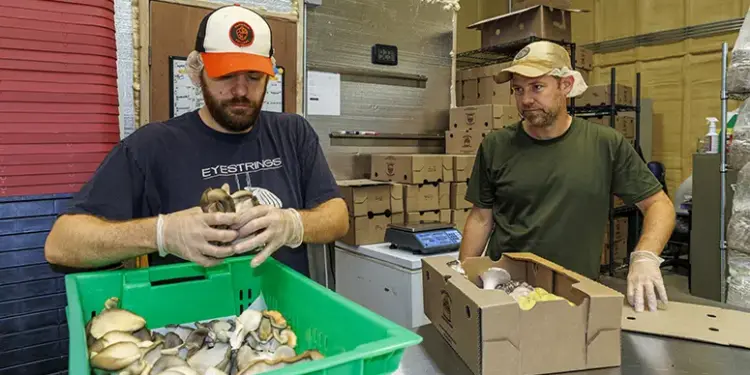
With as amiable a disposition as the now-retired working dogs, farm manager Iain Davis ambles over from the farmhouse, cup of black coffee in hand, ready to give another media tour of the tractor shed, now a temperature-controlled mushroom-growing complex.
Davis lives on-site with farm co–founder and fiancée Kaetlyn Bernal and is the picture of unhurried chill despite an all-hands-on-deck situation mere steps away.
He and the farm’s small team have been extra busy growing and harvesting mushrooms while also updating the facility to prepare for a voluntary audit by the USDA’s Good Agricultural Practices (GAP) program.
As an agricultural crop, mushrooms grow more quickly than almost any other. Still, Manchester Mushroom Farm seems content to try and match their speed with changes of their own to increase output, pursue certifications that qualify them for larger markets and constantly fine-tune the many steps it takes to grow fungi successfully.
“There’s a lot of moving parts in mushroom farming, and it has to go perfectly otherwise the mushrooms just don’t grow,” Davis says.
Said another way, the farm is at a critical junction in its evolution. Customer satisfaction is high, and demand continues to surge, even as the team pursues a potentially seismic growth opportunity.

The USDA GAP certification would qualify them to sell to larger food distribution outlets, such as the Maryland Food Center Authority, which operates a vast wholesale produce market in Jessup, Maryland. This qualification would potentially allow Manchester Mushrooms to reach the entire mid-Atlantic region.
Life happens fast, but for Davis and Bernal, the timeline from teaching school in Baltimore to becoming a regional fungi-growing powerhouse is occurring at nearly mushroom-level speed.
After sequestering on Davis’s family’s farm during the COVID-19 pandemic, the couple caught the itch to work the land. As Davis tells it, “I was a teacher for five years. I loved it. COVID hit. I changed.”
From raising chickens and navigating an unexpected respiratory disease that wiped out their entire flock, to growing fruit orchards and keeping honey bees, plus a lot of trial and error and reinvention, the couple took a curious approach to every pivot and challenge.
That curiosity has led to an awakening of an agricultural passion strong enough to meet the early mornings and round-the-clock logistics with seeming contentment. However, the choice to try mushrooms initially was an almost desperate business calculation. After the chickens failed, the couple needed to pivot to something with a faster growth and harvest cycle.
“Chickens take six months; we didn’t have six months to figure out what’s going on,” Davis says, citing a mortgage, employees’ livelihoods and bills. “We had the money to start a small operation, but we didn’t know if it was gonna work.”
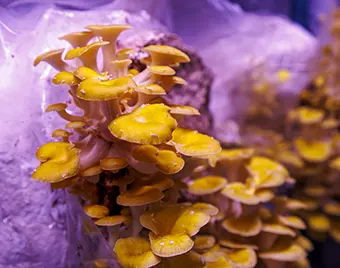
Something is definitely working, however. The farm currently produces and sells about 600 pounds of mushrooms a week, although that figure is temporarily down slightly due to facility upgrades. Immediate plans, however, call for scaling back up to 900 pounds to meet existing demand primarily at farmers markets throughout the Washington, D.C., area.
Carroll County residents can find them at the Downtown Westminster Farmers Market, too. The farm also has a direct farm-to-restaurant wholesale business mainly serving restaurants in Baltimore.
He explains that the dominant preference in Carroll County seems to be for the more ubiquitous mushrooms, such as crimini, button and portobello, which are widely available and commercially grown on a massive scale.
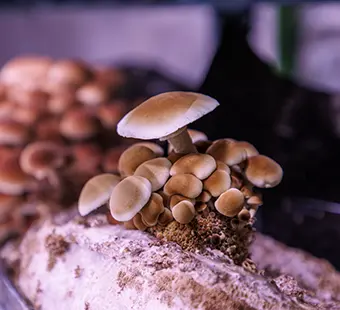
In contrast, Manchester Mushroom Farm grows a more diverse array of fungi like blue oysters, their most popular, the Italian pioppino that’s common in risotto, maitake (also known as hen of the woods) and chestnut mushrooms, among others.
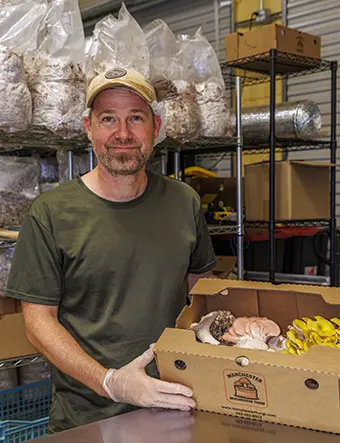
Photo by Nikola Tzenov.
One thing the team takes to every farmers market is a box of recipes for using the mushrooms they grow. Some of their most popular recipes are for a mushroom medley soup and lion’s mane “crab” cakes. Davis says that not only is lion’s mane really good for your brain, but texturally it’s an “awesome crab meat substitute.”
“We make a lion’s mane crab cake that will fool anybody from Baltimore,” he says, daring the crab cake capital of the world to try.
It’s no less than what he dares for himself. Davis dreams of building one of the biggest mushroom farms in the country in Manchester.
“It’s gonna take a few generations. I want my kids to do this. Eventually, we want to make Manchester the mushroom capital of Maryland,” he says, extolling the strategic position of Carroll County and its access to Baltimore, the District of Columbia, Frederick and other potential markets. “It’s right in the middle between all these locations,” he says. “Why wouldn’t I set up a mushroom farm here? It’s perfect.”
There’s another element to laying down roots in Manchester and sticking with mushrooms long term. It’s one of the values Davis, Bernal and the entire farm team embrace and celebrate: the notion of community. It’s also an intentional mindset they bring to their work, fostering community at the farmers markets where they sell, within Carroll County and their home base.
“If you don’t have a community, you just don’t have a business. It’s so fundamental. It just makes the job much more enjoyable,” Davis says.
“We haven’t delivered to restaurants here yet,” Davis says. “We want to introduce these mushrooms more to the local community. We want to make a storefront here, open to the public to be able to buy mushrooms.”
With a notable focus on the future and on what needs to happen now to make that future possible, Davis takes a streamlined view of his journey to this point, through those fateful years that followed his initial departure from teaching.
“I wanted to be able to grow my own food, started with chickens, and somehow, the stars aligned, and I ended up becoming a mushroom farmer,” he says.
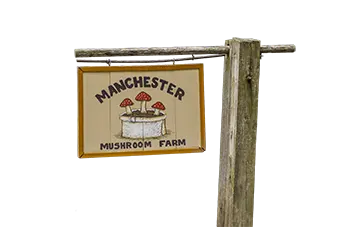 There’s no “somehow” about it. That first turnoff into Manchester Mushroom Farm may evoke storybook images of a mushroom forest. More than celestial orbs, this mushroom farm’s aligned stars appear to resemble hard work, creative flexibility, big-vision ambition and a commitment to community. For Manchester Mushroom Farm, that’s the fairy tale they choose.