by Kym Byrnes, photography by Nikola Tzenov
Television has given us its share of memorable waitresses: Carla Tortelli slinging drinks and insults on “Cheers,” Flo dispensing sass along with diner fare on “Alice” and Rachel Green learning the ropes at Central Perk on “Friends.”
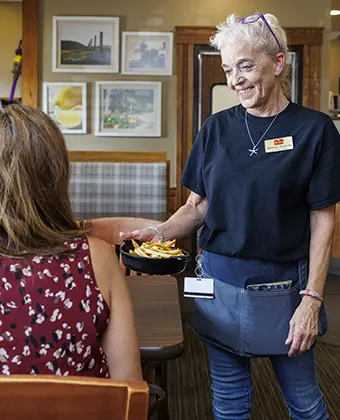
The real-life version is usually less scripted. At Bob Evans in Westminster, three longtime waitresses have spent years doing more than delivering breakfast and refilling coffee. They have built relationships, remembered routines and become familiar faces in the lives of generations of customers.

For Chrissy Roberts and Debbie Gist, that relationship with customers has been developing since 1998. Sarah Swanke joined them in 2014.
Among them, the three women have logged decades of orders, coffee refills, early mornings, crowded dining rooms and conversations with people who have become much more than anonymous customers passing through.
It is work they take seriously. “Personality, friendliness, attitude — it’s a personality thing,” Roberts says. “You can be mad as a hornet behind that line, but when you come across that line you have to have a smile on your face and be ready to go.”
Roberts, 60, started at the Westminster Bob Evans in September 1998, just months after the restaurant opened in April that year.
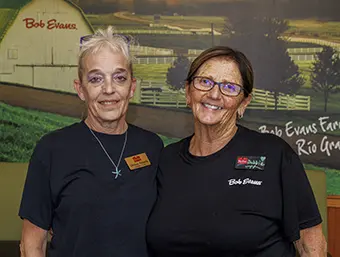
Raised in a large family on a Montgomery County dairy farm, she moved to Carroll County after marrying and has tried several types of work over the years. But she kept returning to restaurants. Before Bob Evans, she worked at The Links at Challedon, where she also served as food and beverage manager.
Roberts thought her future might eventually involve a government job, but nearly 28 years later, she is still at Bob Evans. What has kept her there? “The people who come in, and some of my coworkers. Most of us have been here so long we’re like family,” she says.
Gist arrived one week after Roberts. For her, serving is not only a longtime job. It is essentially the only career she has known.

Gist, 68, grew up in Union Bridge and attended Francis Scott Key High School. She began serving food in 1973, before she was old enough to have a driver’s license. In more than five decades of working, she has had just four jobs — all of them as a server.
At Bob Evans, the regulars make the work personal. “My customers,” she says when asked what has kept her at Bob Evans. “The customers are very nice to us. When you know a name and what they get to drink, it’s a personal exchange. It’s just natural.”
The depth of some of those relationships became especially clear over the past year.
Gist’s husband, Keith, died after spending 11 weeks in the hospital. She took a month away from work to be with him. The couple married while Gist was a senior in high school and would have celebrated their 50th wedding anniversary this year.
When he died, customers from Bob Evans were among the hundreds of people who attended his funeral. That exchange — knowing people and being known in return — is part of what distinguishes longtime servers in a community restaurant.
Swanke sees it with a group she waits on Tuesday mornings. “They’ve come in on Tuesdays for years now,” she says. Members of the group attended the same high school. Over time, some have died, and others have joined them.
A Carroll County native and Francis Scott Key graduate, Swanke previously managed the Ritz Camera at the Westminster mall. When the store closed, she was looking for work and returned to something she had done earlier in life: serving.
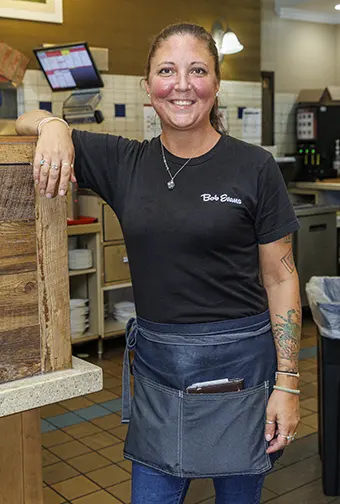
After years in management, she deliberately did not want to be in charge again. At Ritz Camera, particularly around Christmas, management responsibilities often took her away from her family. Restaurant work offered something different.
“It was a relief to not always be on call,” she says. Today, with an 11-year-old son involved in activities such as football, flexibility remains important.
“I make enough money to do what I need to do,” she says. “It means a lot to make sure I’m there for my kids, and this job allows me to do that.”
The wait staff is in constant motion. On a recent shift, Swanke had waited on about 40 tables between 9 a.m. and 4 p.m. and logged close to 7,000 steps before her day was finished.
Servers at the restaurant take orders, enter them into the computer, make salads, prepare soups, cut bread, pour drinks and coffee, gather condiments and deliver multiple courses. Then there is the mental inventory of countless small requests.
Swanke laughed about driving home after work only to suddenly remember something from hours earlier: “Ugh, table 72 wanted ranch,” she says.
Roberts and Gist say they rarely sit down during a shift. Roberts usually arrives early to open the restaurant, and Gist comes in to stock supplies, check tables and windowsills, cut bread and make iced tea and coffee before the dining room gets busy. The pace can also turn quickly.
Five tables may be seated nearly at once. A kitchen backup can slow everything down. A complicated drink topped with whipped cream and chocolate takes longer than pouring coffee, made more challenging when several other tables are waiting. Sometimes customers get impatient. The work involves keeping up and remaining pleasant even when, maybe especially when, chaos ensues.
After nearly three decades, Gist says she has also learned that there is little use trying to predict when the rush will come. “I’ve been here 28 years, and you still can’t ever predict how busy you’ll be,” she says. But some patterns emerge.
Christmas brings families stopping for breakfast or hot chocolate. Out of the restaurant’s windows, one can see trees tied to the tops of their cars. Some parents come in after putting their children on the school bus for the first day of school. There is tradition woven into this experience for people. Community events — festivals, carnivals and fairs — can also change the restaurant’s rhythm.
Plenty has changed about restaurant life since Roberts and Gist started in 1998.
They point out that the smoking section disappeared, as well as the restaurant’s counter seating. The COVID-19 pandemic accelerated carryout service. Even tipping changed: Roberts said servers once walked out with their tips in cash at the end of the day. Those earnings are now distributed with their paychecks.
What has not changed, at least for these three, is the basic formula. Patience. Friendliness. Competence. A willingness to keep moving. A commitment to giving people a really good experience. Gist has no interest in slowing down. “People ask why I’m not retired,” she says. “Because I want to keep moving. When you get my age, a body in motion stays in motion.”
Roberts has no immediate retirement plans either. She has worked other jobs, including earning her CNA and GNA credentials and caring for nursing home residents, while continuing to work at Bob Evans. When she eventually leaves the workforce, she expects it will be from the restaurant.
“I won’t start over someplace else,” she says. And Swanke, for now, is happy where she is.
All three understand that serving is a job. They work because they need to earn a living, and Swanke is straightforward about the connection between good service and good tips.
It may not be the stuff of television sitcoms. But for a few hours over eggs, pancakes and cups of coffee, it creates something increasingly hard to manufacture: the feeling of walking into a place and knowing someone there is glad to see you.