by Bob Blubaugh
Teaching at golf courses typically involves a professional showing frustrated players how to get more distance out of their drives or how to fix their slice.
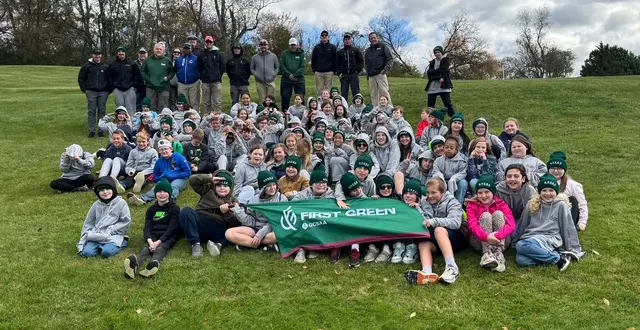
But a few times each fall and spring, close to 100 Carroll County elementary school students travel to Westminster National Golf Course to build on the STEAM education — science, technology, engineering, the arts and math — they’re receiving in the classroom.

Ryan Kraushofer, Westminster National’s superintendent and general manager, has hosted more than 30 field trips totaling approximately 2,800 third- and fifth-graders over the past decade, teaching the Golf Course Superintendents Association of America’s (GCSAA) First Green Program. Students learn about soil and water conservation, put their knowledge of math and physics to use, and even see robots at work during what is likely their first exposure to golf.
Kraushofer attended a demonstration during a GCSAA conference in San Diego a decade ago and became convinced the First Green program could work in Carroll County. “I knew some teachers that helped mentor me growing up through elementary and middle school, and we obviously have a lot of teachers here in our workforce, too, so we’ve got connections to [Carroll County Public Schools],” he says. “Since we hosted the first field trip, they just keep growing and growing.”
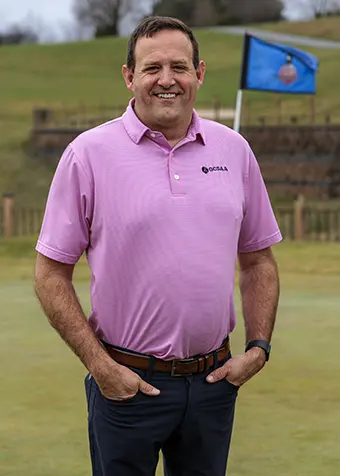
The kids are never far from Kraushofer’s mind. Photographs of them learning hang in his office, as do golf flags signed by the youngsters. Thank-you notes — and even some marriage advice — they wrote him are stored in a nearby file cabinet. Artwork produced during their visits adorns a wall in the clubhouse dining area.
“I was always a firm believer that you have to give back to the community you serve,” says Kraushofer, whose course also participates in a successful and growing Toys for Tots program during the Christmas season.
The First Green kids also get lunch and some swag, receiving hoodies and beanies during their day trip to Westminster National in the fall. Sponsors, the golf course and the First Green program cover all the costs. Stacey Gibson, a fifth-grade teacher and STEM team lead at Elmer A. Wolfe Elementary School in Union Bridge, is sold on the benefits.
“This field trip is very valuable for my students because it is the real-world application of the science and math that they learn in their classroom daily,” Gibson says. “Not only does it expose them to that real-world experience, but it also highlights the careers in STEM that most people never think of, such as golf course management.
“Funding for field trips is often very limited. Ryan and the First Green organization covered the cost of our buses so that we could come on this trip. That level of generosity is few and far between these days,” she adds. Kraushofer, now 42 and a member of the GCSAA’s Board of Directors, began his golf career at age 12, working for Leland Snyder at Oakmont Green Golf Course in Hampstead.

He went through the turf management golf program at the University of Maryland and has been working at Westminster National virtually uninterrupted since the Snyder family bought the course in 2007.
Kraushofer says he gets plenty of help during the First Green sessions from the Mid-Atlantic Association of Golf Course Superintendents, other superintendents from nearby courses who volunteer their time and the many chaperones and CCPS educators who attend. He notes that former county STEM coordinator Bryan Shumaker played a major role in building the curriculum.
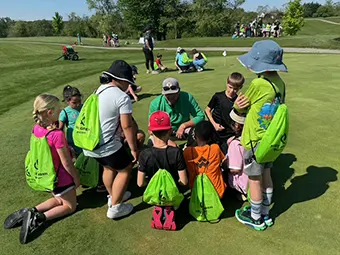
According to the GCSAA, the First Green program is a STEAM environment outreach initiative that aims to partner with schools to provide unique learning opportunities. First Green, which started in Washington state and had gained little traction when Kraushofer was introduced to it in San Diego 10 years ago, is now active in 48 states, with more than 25,000 students participating.
The program continues to evolve, but Kraushofer’s version currently consists of seven stations covering various STEAM aspects:
- 411 of Golf: Students learn about physics in golf, such as how club loft affects shot distance. After each shot, they measure the distance and convert feet to yards. Golf Course Architecture: Students learn what goes into designing a course and what features are needed to benefit wildlife. They are allowed to draw their vision of a golf hole.
- Math: Course superintendents need to calculate the area and the proper amount of seed, fertilizer or topdressing to apply. Students figure out the square footage of a tee box and learn how averages are used to determine applications.
- Putting: Students learn the proper way to putt and read greens.
- Robotic Mowers: Robotic mowers use a combination of technologies to operate autonomously, and complex algorithms determine mowing paths.
- Soils: Golf courses are large parcels of land with healthy turf, trees and other vegetation that can provide wildlife habitat and, in many cases, restore environmentally damaged sites.
- Water Conservation: Efficient water use is a critical component of golf course maintenance, with supplemental irrigation needed to maintain healthy turfgrass throughout the season.
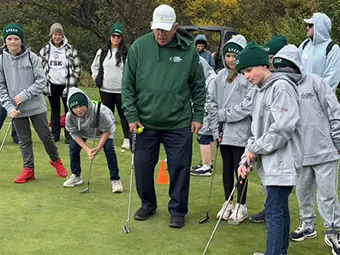
“These stations are tied directly to my fifth-grade science curriculum that looks at conservation of natural resources and how humans use science to solve real-world problems,” Gibson says.
“Ryan, the field trip, and the entire process from start to finish are a dream for a teacher like me.
I always try to provide real-world experiences for my students wherever I can, and the fact that Ryan and his organization are so willing to go above and beyond to make it happen means the world to me. Clearly, “giving back” and teaching are important to Kraushofer. But there is another possible benefit.
Some kids might be inspired by the experience to take up golf or get a job at the course. Perhaps one day, someone who participated in First Green at Westminster National at 8 or 10 years old will go on to learn turf management and get into the golf business. “One of the biggest challenges in our industry is labor. We always talk about how you have to attract, train and then retain them,” Kraushofer says. “This can be step one.”
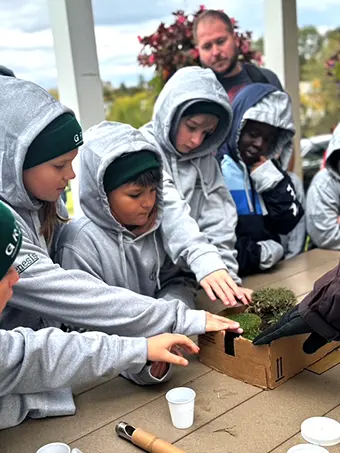
First Green is eye-opening for the students, who often don’t know what to make of the golf course when they first set foot on it. Kraushofer says he usually begins the day by having the entire group sit on the practice green. He then asks if they think they are on real or fake grass.
“A lot of times you hear ‘fake,’” he says. “And so we tell them, you’re sitting on millions and millions of little tiny plants right now.”
By the end of the day, they’ll understand why the fields at the sports complex across Route 97 from Westminster National would drain better after a rainstorm if they were sand-based rather than clay-based.
They’ll also hear about why a golf ball will go farther after being hit with a driver than with a 7-iron, as well as how golf courses improve air quality. “Each kid has something unique that sticks with them, whether it’s math, science or art,” Kraushofer says. “It’s really cool to see that it’s not just the fun they like. They’re picking it up.”