by Lisa Gregory
Local birdwatchers never know what they might find outdoors. Just last year, Dave Hudgins was alerted on eBird, an online database of bird observations, that a roseate spoonbill was in the area. He eagerly went to see the pink-hued waterbird for himself.
“That’s an unusual bird to see in Carroll County,” says his wife Michelle, the president of the Carroll County Bird Club. “It’s beautiful.” From a roseate spoonbill to more commonly seen birds, birdwatching offers a delight of spectacles. “So many different colors, sizes and behaviors,” says Westminster resident Maggie Kunz, vice president of the club. “The more you learn about them, the more you enjoy them.”

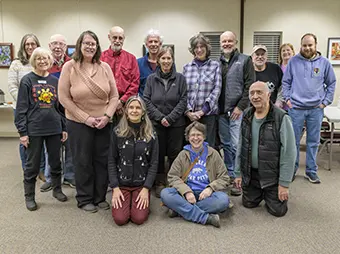
The Carroll County Bird Club, affiliated with the Maryland Ornithological Society, began in 1979, with members meeting at individual homes.
Today, the club meets at the Carroll Nonprofit Center in Westminster and has upward of 80 members, with 20 to 30 in attendance each month, according to Michelle.
Michelle and Dave have been part of the club from its start. The two became interested in birdwatching as a young married couple.
“We were on the third floor of an apartment building, and there were woods behind us,” says Michelle. “We got binoculars and began birdwatching.”
Today, the couple lives on 13 acres, mostly woods, in Finksburg. Scott Hodgdon and his family joined in 2017 and have become dedicated and active members. “Birding is an easy thing to do,” says Hodgdon. “You can do it year-round, and you can do it almost anywhere.”
A Mount Airy resident, Hodgdon, who is the club treasurer, began his interest in birds as a boy. Once he had a child of his own, now-grown son Matthew, he continued the tradition. “He was about 3 when we bought him a bird feeder and would watch what came to the feeder,” says Hodgdon. Birdwatching is a family affair, including Scott’s wife, Virginia. The family dog, Abby, even goes along on birding walks.
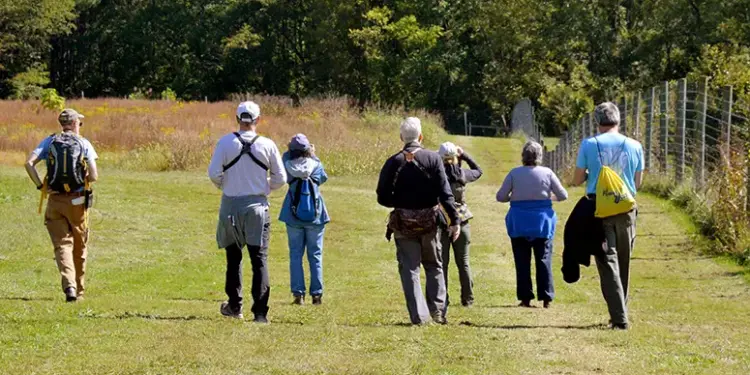
Monthly club meetings include discussion topics such as birding in Puerto Rico. The club conducts bird walks to observe birds, such as woodcocks, at Morgan Run Natural Environment Area in Eldersburg. “The woodcocks do their mating ritual at a spot over on Morgan Run and return each year,” says Michelle. The club also offers birding trips farther away, such as Ocean City.

“There are 450 existing species of birds documented in Maryland,” says Hodgdon. “In Carroll County, 200 species occur.” Worldwide, there are more than 11,000 species, according to the Cornell Lab of Ornithology at Cornell University.
Growing Knowledge Through Education
No matter what one’s level of knowledge, all those interested in birds are welcome. “The best tool is getting out and birding with other birders,” Hodgdon says, “learning the little things that they’ve learned over the years.” This birding education includes not only how to identify a bird by sight but also by sound. For example, Michelle’s favorite bird, the wood thrush, “has a flutelike sound,” she says.
“So many different colors, sizes and behaviors. The more you learn about them, the more you enjoy them.” — Michelle Hudgins, President, Carroll County Bird Club

Besides nature talks and birding walks, the club participates in local bird counts during the winter, spring, and fall. “It’s important information on the bird population and how it is doing,” says Michelle. “We’re not only counting individual species, but we’re counting individual birds,” adds Hodgdon. The count numbers are given to the Maryland Ornithological Society.
In 2025, for example, the club’s spring count recorded 136 species and 7,114 individual birds, with 27 birders participating for a total of 116 hours — some on foot and others by car. Those on foot “may do 10 or 12 miles a day,” says Hodgdon. “We’re citizen scientists.”
Bill Ellis of Eldersburg, a co-founder of the Carroll County Bird Club and a lifelong birder, agrees. “It has scientific value,” he says, “and it’s fun.” He has, however, noticed some disturbing trends, such as with warblers. “Their numbers are becoming smaller and smaller,” he says of the tiny, colorful birds with the long migration patterns.
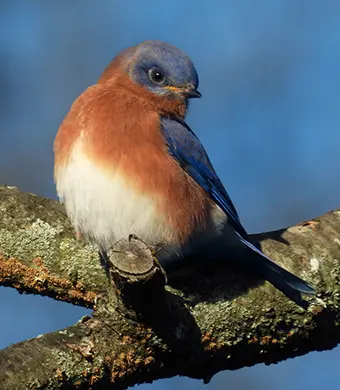
Photo by RoseAnn Schuler
Both migratory birds and year-round residents are counted. “We try to maximize the diversity of what areas we’re going to,” says Michelle. “We have people who will go to the reservoirs. We have people who go to the woods. We have people who go into the fields of western Carroll County, where there’s more grasslands. You get a diversity of birds from different areas.”
The counts matter now more than ever, says Hodgdon. “We are seeing a decline of all bird species in general,” he says of the world’s bird population. According to recent studies, nearly half of the world’s bird species are in decline.
One of the biggest culprits in bird decimation is the feral and pet cat population, which kills more than 2.6 billion birds in the United States and Canada each year, according to the website 3BillionBirds.org. Other concerns include habitat loss, climate change and pesticide use.
From Bird City to Backyards
Help is on the way, however. Education and preservation are a huge part of what the club does. In 2025, through the club’s efforts, spearheaded by Kunz, Westminster was designated an official Bird City by the Bird City Maryland network.
Westminster is only the ninth city to become a Bird City since the state program began in 2019. A Bird City gets recognized for its efforts to increase bird habitat, reduce threats to birds, educate and engage people about birds, and promote sustainability.
“There are 450 existing species of birds documented in Maryland. In Carroll County, 200 species occur.” — Scott Hodgdon

Kunz sees Westminster’s Bird City designation as a win-win for both human and bird residents. “It’s about encouraging the city to continue to improve its green space,” she says. “It’s good for all of us. It helps people connect to nature.”
According to Kunz, the city had already done much of what would be required to become a Bird City before the designation. Wakefield Valley Park, a former private golf course, has been transformed into a popular green space. “The city has done a lot to restore habitat there,” says Kunz. “They planted a lot of trees and are getting rid of some invasive species and making sure native species are planted. That’s really beneficial to birds.”
As part of the Bird City designation, an online vote occurred to determine Westminster’s official bird, with the eastern bluebird selected. Other conservation efforts by the club involve working with the Maryland Farmland Raptor Program, an initiative of the Maryland Bird Conservation Partnership.
The program includes focusing on the American barn owl and the American kestrel. The habitat environment for these birds is under great stress and diminishing, says Alex Pellegrini, Maryland Farmland Raptor Program coordinator.
According to Pellegrini, American barn owls have declined by 79% in Maryland during the last 40 years. The program is working to install nest boxes for American barn owls and American kestrels to increase nesting opportunities at no expense to landowners. The nest boxes are monitored, and data on behavior and habitat use are collected.
“Anything we can do to encourage them is wonderful,” says Waiva Worthley, a club member and veterinarian who is actively involved with the effort and lives in Finksburg. Given its agricultural culture, Carroll County is a perfect fit in many ways.
“I have been reaching out to people that I know who own properties that look like they would be good nesting habitats,” she says, “properties with unused silos because of the height.”
While it is still the early days for Carroll County in the program, Worthley says she has met people interested in participating. “There is a strong connection between the agricultural economy of our county and the environmental health of our county,” she says. And birds matter, she says. “They are so remarkable in so many ways.”