by Kym Byrnes, photography by Nikola Tzenov
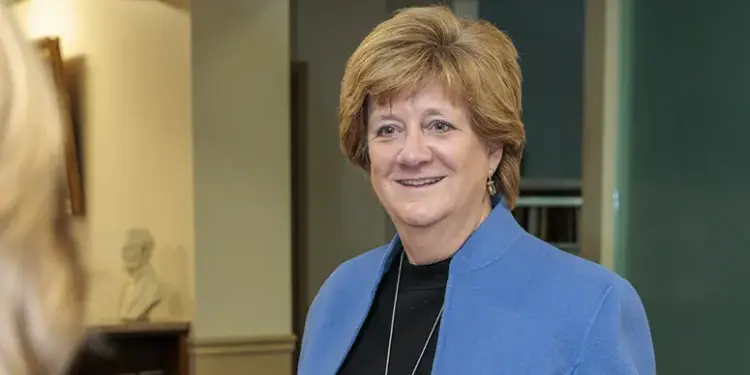
After decades representing Carroll County in Annapolis, Susan Krebs thought she had closed the book on public office. When a seat on the Carroll County Board of Commissioners opened, she put retirement on hold.
Appointed to complete the term, Krebs returned to service with the same steady resolve that has defined her career. A Baltimore County native who married a farmer from Upperco and has called southern Carroll home for 43 years, she’s built a life rooted in family — 43 years of marriage, three children and eight grandchildren — and in the rhythms of a community she knows intimately. Krebs reflects on how Carroll County has evolved, where she believes it’s headed next, and the issues she considers most critical to its future.

What originally attracted you to public service? What has kept you engaged all these years?
I am an accountant by trade, a financial person, and in my early years living in the South Carroll area, it was clear this part of the county needed representation on the [Carroll County] board [of education]. The schools were overcrowded, and the PTAs were driving the advocacy work for new schools. So I served on the board of education and, from there, went on to represent Carroll at the state level. That’s why I’m here. Even today, that area needs advocates as it continues to grow.
Being an elected official isn’t something I ever aspired to. I don’t care about the title, but the job gives me a platform to get stuff done — not just talk but take action. Being able to solve problems — individual or community — and help someone get something accomplished, that’s been the rewarding part. You never do anything alone; you either influence it or are part of it, and it’s meaningful. I don’t think of myself as a politician; I prefer to call it public service.
What are some key differences between working in the Maryland General Assembly and serving in county government?
Politics drives spending and priorities, and those at the state level might not be in line with how counties want to operate. In Carroll, we have commissioners, and you can make a plan and implement it. At the state level, you can accomplish a lot, but it takes a lot of time. At the county level, we have a budget we control, and where you spend money is where your local priorities are.
What shifts in the county have stood out to you the most during your time in public office?
There’s a lot that doesn’t change. We’re still an agricultural community. People move here because they want a little piece of earth. They come here for schools; they come here to raise families. Overall, we’re a conservative county where people are concerned with helping each other and being philanthropic, and where the nonprofit sector is amazing.
I do see some pulling back in terms of getting involved. We need more people to step up, get involved on boards and commissions, and participate in work groups. You’d think we’d be more informed through social media, but I think we’re less informed about our community, and we may even be getting bad information through social media. The county is working to keep citizens engaged and informed through services like Carroll Connect and [the county] website.
“Being an elected official isn’t something I ever aspired to. I don’t care about the title, but the job gives me a platform to get stuff done — not just talk but take action. Being able to solve problems — individual or community — and help someone get something accomplished, that’s been the rewarding part.”
What do you think are the biggest challenges facing Carroll County over the next decade?
First, the state is trying to control what we do at the local level. It creates real issues when they tell us what to do with housing, but don’t also address roads, schools, utilities, powerlines, and everything that comes with more housing. We also need to realize that we have over 80,000 acres of farmland preserved, and unfortunately, farming has become very difficult. It’s tough to make it financially viable. Farming might not be the economic engine for Carroll County. We can preserve it, but now we have to ask what we want to be when we grow up.
And there are our towns: If you’re not growing, you’re struggling. We’ve got to help our towns. Union Bridge needs a new wastewater plant, but 900 residents can’t absorb that cost. We need to help the towns get the infrastructure in place so we can see growth across the county, not just in one area.

When we start losing population in our existing towns, it threatens schools. And one more ongoing conversation is PFAS [“forever chemicals”] remediation. How do we move forward with that? It wasn’t even a thought years ago, and now, suddenly, the dollar amounts to clean this stuff up would eat an entire budget for many years. How far do you go with that? It has to be a balance.
Is there anything that still surprises you in this line of work?
I learn something new every day, and that’s what’s so exciting about it. This is a great place to live. We need to make sure it stays that way. We need to be responsible and inclusive, listening to people and understanding that we’re all on the same team here. We don’t all have to agree all the time, but we do have to have dialogue.
What’s next for you in your career?
I will finish this term and run for one more. To make it worth doing the work, to really move the dial in getting something done, you have to commit to more than a year in the position. My goal is to get more people involved. When I first ran for office, 10 people were vying for a position; now, there’s hardly any competition. You want a healthy pool of people running for office, which makes for a healthy government. It’s so rewarding to get involved; we need to encourage more of that.