
by Linda L. Esterson
For his entire life, Ted Zaleski has maintained a passion for reading. As “a loyal friend to every book he meets,” he says, his extensive collection is proof of his love for words.
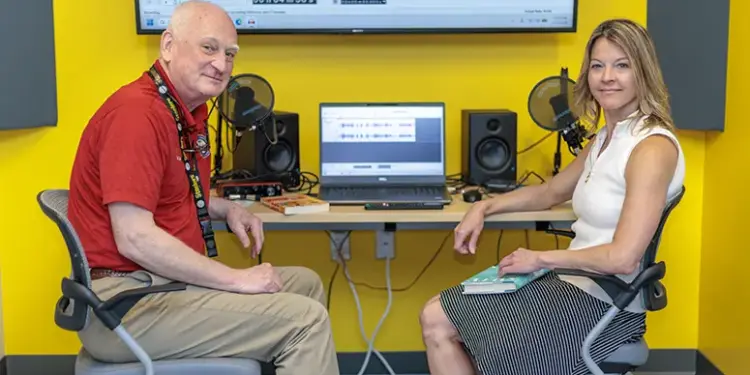
It’s no surprise that Zaleski would find a way to share his interest in books, writers, libraries and bookstores. In 2022, Zaleski and his friend Lory Hierstetter launched “Two Sides 2 the Story,” a podcast aimed at promoting local bookstores and literacy in Carroll County.
Both are county government employees by day — Zaleski is director of management and budget, and Hierstetter serves the human resources department as division manager of talent management — and they connected through their mutual love of books. After a few months deliberating, they agreed on the current approach and the name, which plays on their contrasts — interest in fiction vs. nonfiction, planning vs. “pantser” (writing by the seat of your pants) styles and different gender perspectives.
Seventy-six episodes later, the two have shared stories about local and well-known authors, bookstore owners, booksellers and librarians.
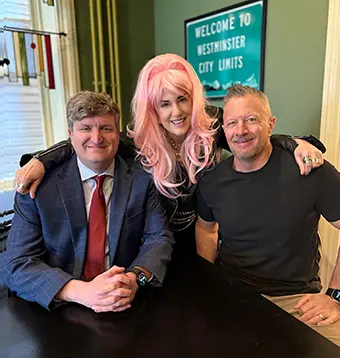
“We’ve definitely had some surprises along the way,” says Hierstetter, also an avid reader and book collector since childhood. “The biggest one was John Waters. We’ve actually interviewed him twice.”
While the podcast is recorded primarily at the Westminster branch of the Carroll County Public Library, its sources come from all over. Hierstetter and Zaleski meet authors and bookstore owners at book festivals, both locally and out of town, and they make connections with others through the people they encounter. When they’re on vacation, they’re scouting for bookstores. On a trip to North Carolina, Zaleski visited eight.
“It’s much more than we ever anticipated,” he says. “In probably nine different states [plus Washington, D.C.], we’ve touched a bookstore or a book festival.”
Listenership has grown since the beginning, and with a website, Instagram account and streaming on Apple Podcasts, their reach is expanding. Most shows have logged around 150 people, Zaleski says, while a few have peaked at over 600.
The podcast, which requires many hours of preparation, averages a new episode each month. The two don’t sell advertising and are not looking for income.

More to Hear Locally
When Chris Swam first joined Carroll County Government’s communications office 22 years ago, the county commissioners recorded a weekly 10-minute address on tape that aired on WTTR radio. Swam, the department’s digital communications manager and webmaster, transitioned the effort to digitally-recorded podcasts about 10 years ago.
Today, the commissioners often record on their own, whether on provided equipment, in the communications studio or on their phones. Podcasts are streamed on a YouTube channel, shared to subscribers through the Carroll Connect email communication system and posted on the county’s website. However, few have recorded new episodes since the start of 2026.
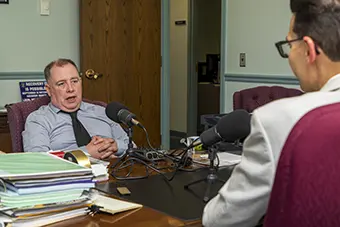
“It’s a great way for them to actually talk to and communicate what they’re up to, to their constituents,” Swam says.
Another local podcast dropping periodically is McDaniel College Athletic Department’s “Green Terror Talk.” Host Avery Newport, assistant director of athletic communications, initiated the audio-video show to preview sports seasons when he joined the department two years ago. Episodes stream on Spotify, Apple, Amazon and YouTube.
Newport interviews a team’s head coach and sometimes a student-athlete. “We consider the best ways we can engage with our fans, our students, our athletes, their parents, donors and people who might be interested in the program,” Newport explains.
Videos for the small private college generally log around 100 views, with a few exceeding 1,000. Newport has also heard from broadcasters who used the podcasts to learn more about McDaniel’s teams.
Not Without Challenges
While many podcasts run for long periods with loyal followers, others struggle to sustain listeners. Inherent challenges to podcasting include securing equipment, time, guests, research, marketing and, of course, generating ideas.
Beginning in 2018, a group of four men, including Randy Goldstein and Dennis Twigg, hosted an audio podcast called “Carroll Worldwide” that made light of stories and debate in Carroll County local Facebook groups. The first episode, 10 minutes long, garnered somewhere around 1,000 listens.

That episode spawned weekly 15-20 minute sessions that parodied and lampooned the disagreements Goldstein and Twigg read online. They had sponsors — one paid them in pizza — and admittedly enjoyed their newfound hobby. When the others could no longer continue, Goldstein and Twigg approached Sherri Hosfeld Joseph, owner of Birdie’s Café, who was well-connected to the community and had a large personality and sense of humor.
When the trio met, Joseph presented a notebook full of suggestions for improvement. Soon after, she was seated at a microphone, offering a comedic view of the county’s goings-on.
With recording limited to Zoom during the pandemic, the shows were dropped biweekly through 2024. Then, schedule changes occurred. After a hiatus, the programs resumed, but the ugliness of Facebook impacted their desire to continue.
“We couldn’t really make light of stuff because people were getting so nasty and negative,” Goldstein says. “We tried to stay not political.” Late in 2024, Joseph endured a serious health issue, and the podcast ended.
“What we had was genuine chemistry,” she says. “I don’t think it would have ever worked if you had removed even one of us randomly from the situation. We’re three very different personalities, but it meshed so beautifully, and it was so funny on so many levels. Maybe someday we’ll pick it up again, and we’ll have a different take on the world.”
Getting Started
Technology is key to creating a podcast. “The definition of the podcast has changed,” Swam says. “It was strictly audio. Now it’s a television production.” Zaleski suggests viewing existing podcasts before sitting down to create one.
Anyone can create a podcast, Hierstetter says. But you have to be willing to commit the time to prepare and record the podcast, and to ask for help — even hire people if needed.
“If you’re going to make a podcast, it should be about something that you love to talk about, because you’re going to spend a fair amount of time talking about it, or it’ll be a short show,” she says.
Producing a Podcast
Creating a podcast can be easy and inexpensive, according to Elia Powers, an associate professor at Towson University who teaches a podcasting class. Recording can be done on a smartphone with a microphone costing just a few hundred dollars. A soundboard for mixing sound from multiple sources can cost up to $100, and editing software can add to the expense. Spotify and other platforms offer free posting, but if marketing and extensive distribution are desired, there may be fees for those services.
There’s also the expense of time. Creating a podcast isn’t strictly about sitting down to record a conversation. Many people, Powers says, underestimate the amount of time it takes to create a podcast, and for most, there is minimal, if any, income generated from the endeavor. Some can sell advertising or sponsorships, which are played as commercials during the podcast, but sponsorships are more common for podcasts with listenership in the thousands.
“A lot of people continue to do it, even if it’s not necessarily a revenue generator, [because] they like to have a platform, and have a way to reach people,” Powers adds. “A lot of podcasters say they really value… having somebody every week to hash out things with, or just to sort of talk about what they’re thinking about or feeling. It’s a chance for them to be in the public and interact with people.”